Overview
GOALS
- Increase engagement with fans and attract new viewers by offering a unique and exciting way to experience live football matches
- Provide greater accessibility to live football matches for people who may not be able to attend the games in person.
- Generate revenue through increased viewership and the ability to offer premium virtual reality experiences to fans for an additional fee.
- The primary goal of incorporating virtual reality technology into live streaming football matches is to provide fans with a more immersive and engaging experience.
ABOUT
“This App has made me feel very much like I'm part of the team. A Blue i have always been, I can feel the Stamford Bridge atmosphere from here. I love Chelsea FC and the App, in a way puts me In London...” - Wilson Ndlovu.
Virtual reality (VR) is an immersive technology that allows users to experience a simulated environment as if they were physically present in it.
One of the many exciting applications of VR is the ability to watch live sports events in a fully immersive way, as if one were actually at the game.
This document will provide an overview of the introduction of VR into a live football viewing experience at the Stamford Bridge.
Understanding
People
To obtain comprehensive information for this project, a combination of primary and secondary research methods were utilized. Primary research involved conducting direct interviews and surveys with individuals to gain a deeper understanding of their needs and pain points. However, due to geographical limitations, additional data was necessary. To address this, secondary research methods, such as data scraping from Google Play store and the Apple App Store, were employed. Both qualitative and quantitative data were utilized throughout the course of the research, ensuring a well-rounded analysis.
Data Extraction
Process
- Installation & Importation of Libraries
- Data Scraping
- Sentimental Analysis
- Exploratory Data Analysis
Libraries Used
- Tensorflow
- Transformers
- Plotly Express
- Numpy
- Pandas
- Json
- Google Play Scraper
- App Store Scraper
- Torch Torchvision Torch Audio
- Pyyaml
- Matplot
- Pipeline
In order to accurately represent the user population of the "Chelsea FC - The 5th Stand" app, data was collected from both the Google Play Store and the App Store. Python was chosen as the extraction tool due to its extensive data manipulation and extraction libraries. The open-source packages "google_play_scraper" and "app_store_scraper" were utilized for data scraping. To clean and organize the data, the Pandas library, built on top of Numpy, was used. A sentiment analysis was also conducted to distinguish between positive and negative reviews, utilizing the transformers library. The resulting dataset was then organized and prepared for analysis.
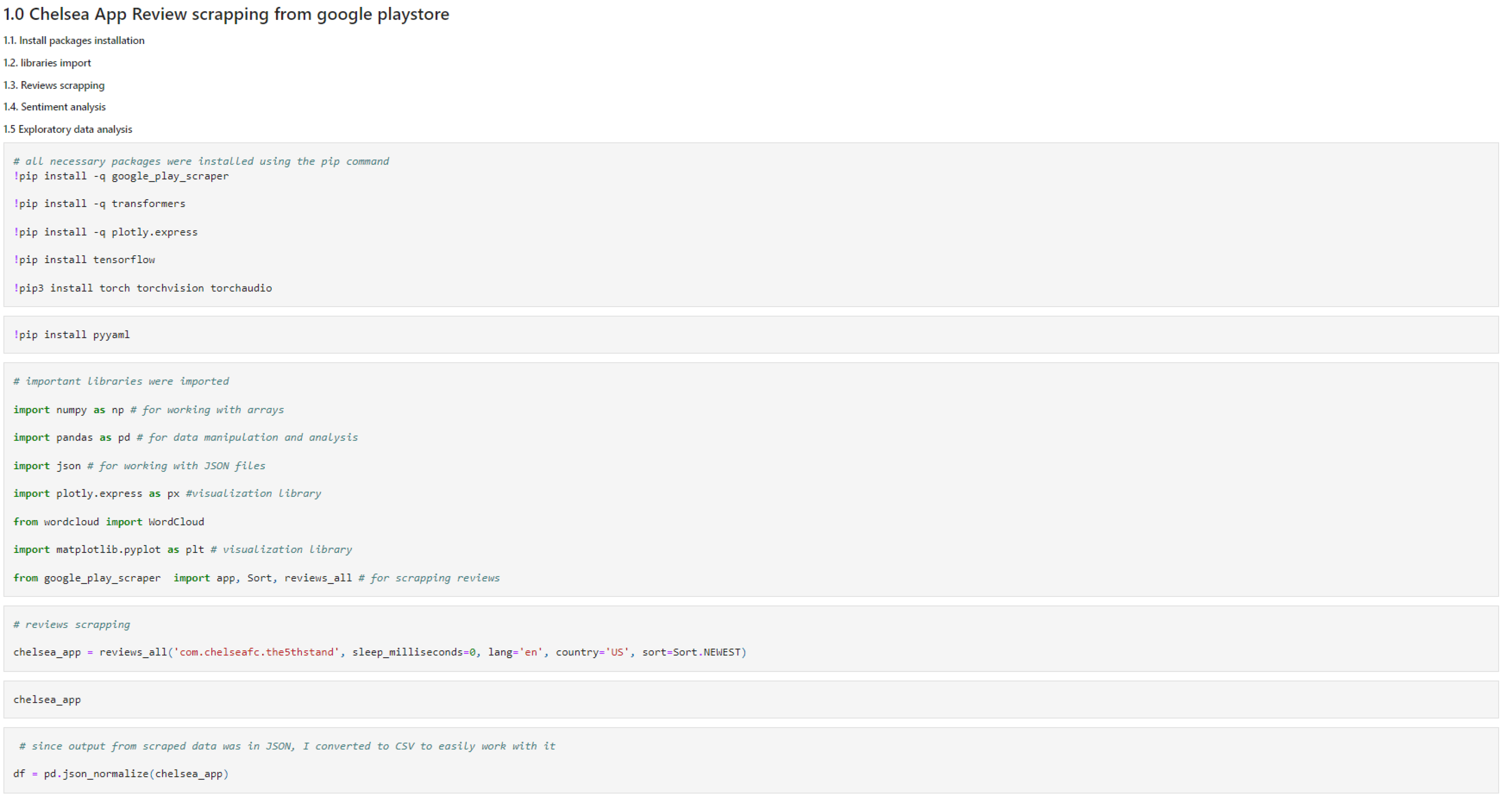 View entire Data Collection Process here
User Reviews
The data extraction process allowed us to gather a large number of user reviews, providing valuable insights and we found that a
common request among customers was the addition of a live streaming feature for football matches, we also found out that
Fans wanted to feel more at home and connected to their favorite club. This feedback was taken into consideration and what
better way to make them feel at home and enjoy a live match than the introduction of a virtual live stream feature,
which allows the fans have the experience of a live match at the Stamford Bridge even being far away.
We extracted 46,245 reviews from both stores for this document. Of these, the following reviews were particularly relevant:
“I have been a Chelsea fan since I was born, passed down from my dad to me, so seeing all news about CFC has been great and exciting, I never miss any game and I wish that one day I would be able to go to Stamford bridge to watch a live Chelsea match. Keep winning blues because you always make me proud to be a Chelsea fan.”
"This App has made me feel very much like I'm part of the team. A Blue i have always been, I can feel the Stamford Bridge atmosphere from here. I love Chelsea FC and the App, in a way puts me In London..."
“Its been a wonderful experience having this app on my phone, it makes me closer to Stamford bridge though far away.”
“The 5th stand brings me so close to Stamford bridge right here even in Nigeria I feel like am in London watching. Thank you for a great support and job you do.”
“I’m American and being able to listen to the home commentary out of Stamford bridge is a real treat as i watch/stream the game. great stuff”
"I live very far from Stamford Bridge, - (Los Angeles), but I grew up in SW19, and am a lifetime Chelsea fan. This is a great way to stay in touch with events and interviews."
There are so many Chelsea fans who would love to be able to watch the team play live, even if they are far away from Stamford Bridge. This got us thinking - why not bring Stamford Bridge to them and make them feel at home no matter where they are.
Proposed
Solution
The proposed solution involves the implementation of virtual reality technology in the live streaming of football matches, with the goal of enhancing the viewing experience and allowing fans feel a greater sense of immersion and proximity to Chelsea FC and to the Stamford Bridge.
Features
The proposed solution will include the following features:
- Virtual live streaming of football matches;
- Virtual attendance at live press conferences;
- A virtual marketplace for Chelsea FC merchandise and other items.
Accessibility Considerations
In order to ensure accessibility for all users, closed captions and alt texts will be included for deaf individuals. Additionally, virtual reality headsets come equipped with Crack Sound enhancements for individuals who use hearing aids.
Design
Process
VR Design
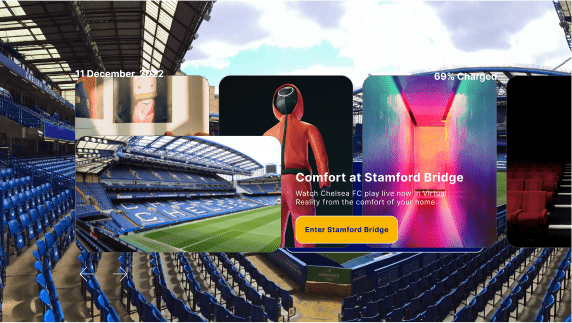
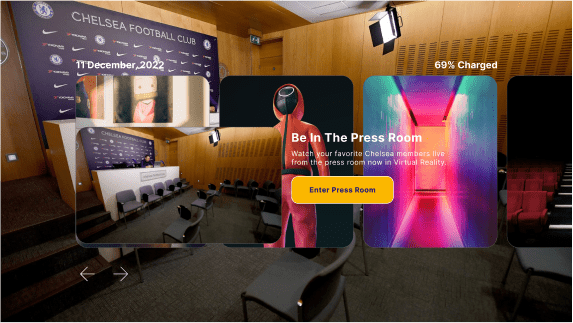
The design for this project was created on a 1920 by 1080 artboard, adhering to both the brand colors of Chelsea FC and the VR design guidelines.
The design will feature a minimal interface, intended to be user-friendly and easy to navigate with the following options:
- Virtual live streaming of matches,
- Virtual attendance at live press conferences,
- Access to the Chelsea FC virtual marketplace.
Below is a visual representation of the proposed design, a GIF illustrating the virtual environment, and a link to the virtual design featuring a VR depiction of Stamford Bridge.
CLICK HERE TO ENTER STAMFORD BRIDGE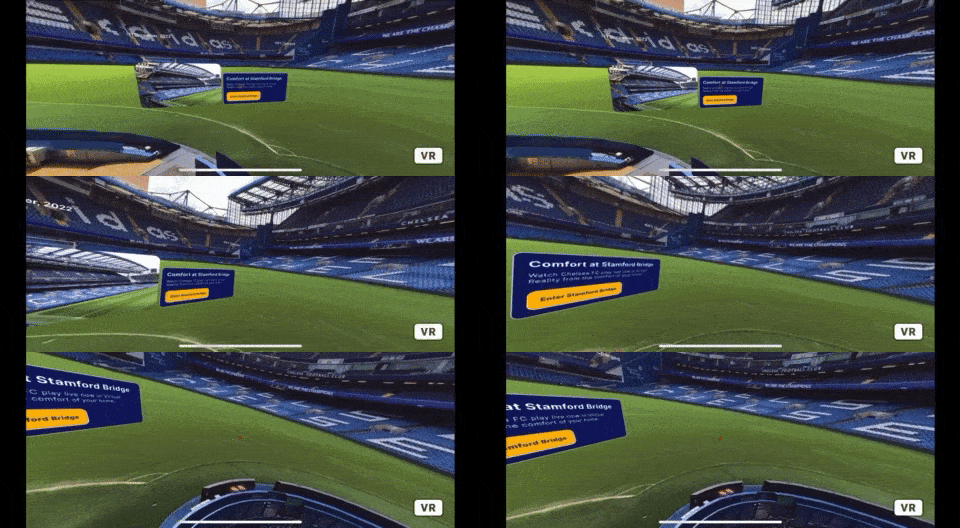
Product Design
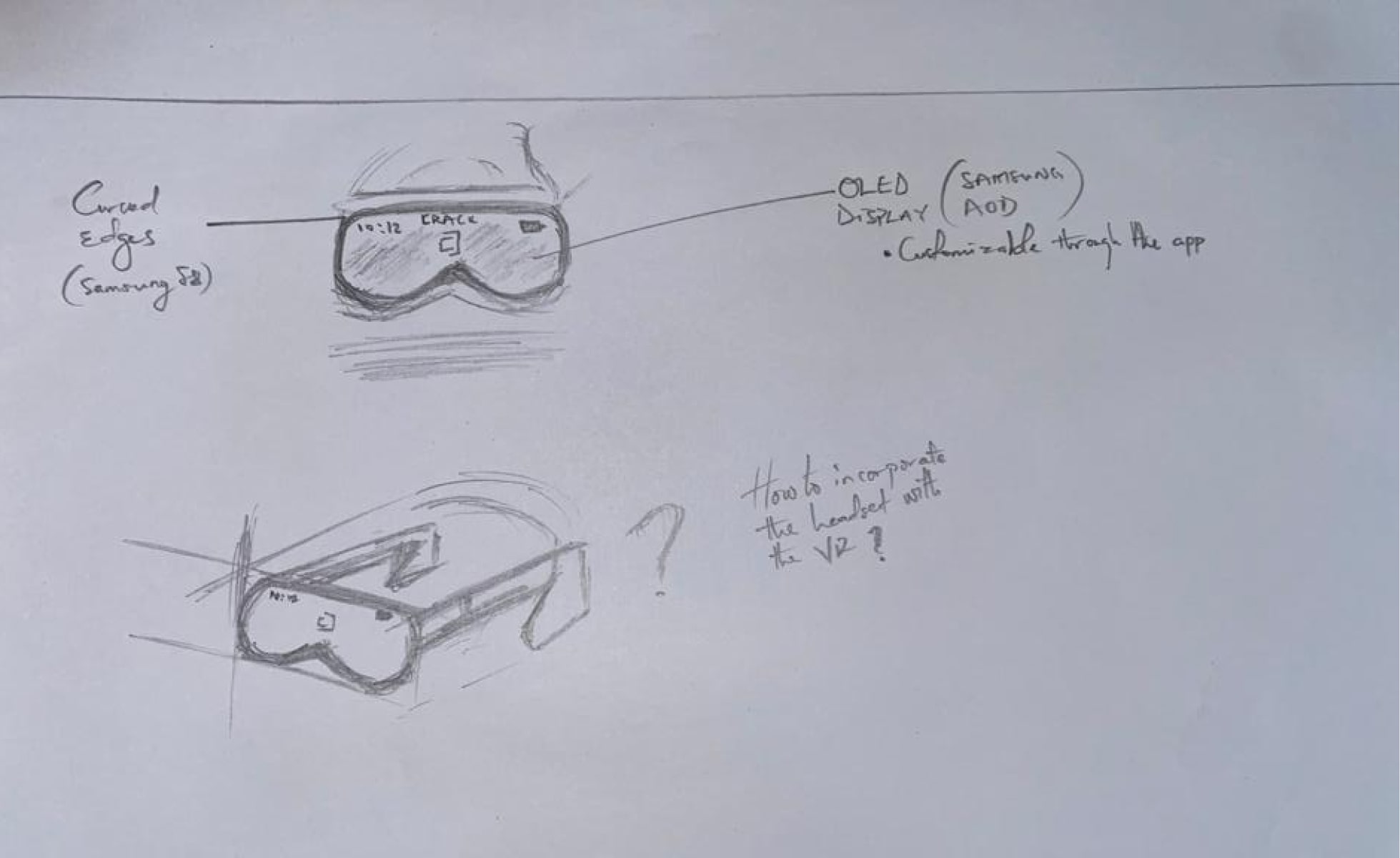
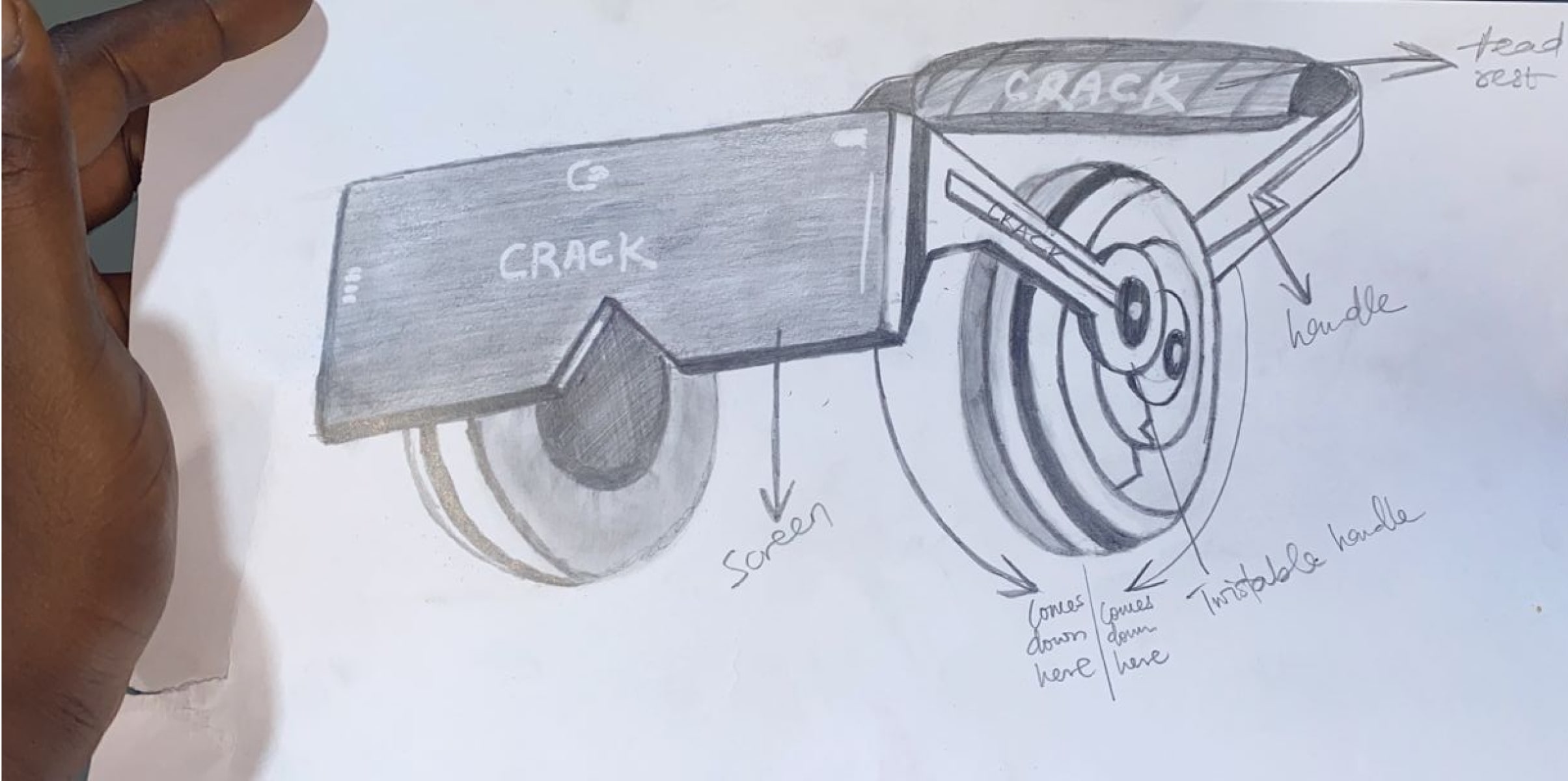
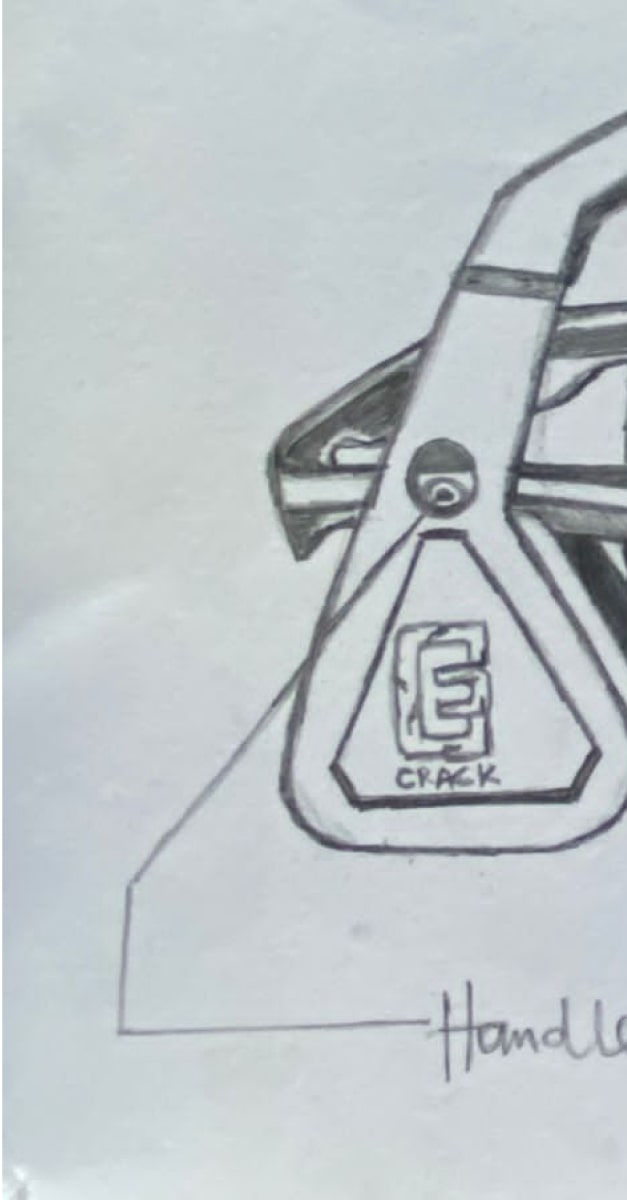
We wanted the virtual reality headset to incorporate the triangular design of the traditional Crack headphones. The headset features a built-in speaker,
which will be calibrated tuned by Crack, as well as an Amoled display on the front of the headset.
The headset will be a CrackLabs x Chelsea brand.
Sketches
We wanted the virtual reality headset to incorporate the triangular design of the traditional Crack headphones. The headset features a built-in speaker,
which will be calibrated tuned by Crack, as well as an Amoled display on the front of the headset.
The headset will be a CrackLabs x Chelsea brand.
Market
Analysis
Cost Analysis
During a brief cost evaluation, the following two questions were considered:
- What equipment is necessary for the establishment of a virtual reality system at Stamford Bridge?
- What is the estimated cost of establishing a virtual reality system at Stamford Bridge?
What equipment is necessary for the establishment of a virtual reality system at Stamford Bridge?
To create a virtual reality experience of the Stamford Bridge, we will need a number of high-quality cameras to the capture 360-degree video of the stadium and its surroundings.
We will also need specialized VR capture equipment, such as VR rigs or multi-camera arrays,
to ensure that the video is captured in a way that can be seamlessly stitched together to create a seamless VR experience. Additionally,
we will need a range of support equipment, such as tripods, stabilizers, and lighting, to ensure that the video is captured with a high level of quality.
Ricoh theta cameras and GoPro VR cubes will also be needed.
What is the estimated cost of establishing a virtual reality system at Stamford Bridge?
In order to provide a satisfactory response to this question, it will be necessary to conduct additional cost analysis research to determine the exact cost of establishing a virtual reality system.
Club Revenue
There are several methods by which the club will profit from this project, including:
- A monthly subscription fee from users;
- Virtual stores offering the sale of kits and non-fungible tokens (NFT) collectibles;
- The sale of VR headsets
Other
Benefits
Safety
A research study conducted by Marc Fabel and Helmut Rainer explored the correlation between football-related violence and societal violent crime.
The findings indicate that there is a 21.5% increase in violent crime on match days. Additionally, the study determined that professional
football matches account for 8% of all violent assaults and incur approximate social costs of 194 million Euros.
The implementation of Virtual live streaming in the realm of football is intended to provide users with a sense of security while experiencing the events at Stamford Bridge.
Improve accessibility
The implementation of virtual live streaming technology at Stamford Bridge for football matches would facilitate increased accessibility to live football matches for people who may not be able to attend the games in person. The project aims to make the matches accessible to people who may be geographically distant, have mobility issues or disabilities, or other constraints.
Generate revenue
The project should aim to generate revenue through increased viewership and the ability to offer premium virtual reality experiences to fans for an additional fee. The virtual reality aspect could also be used to provide sponsored content and advertising opportunities.
Gather Data
The project should aim to gather data on user engagement and behavior to further improve the virtual reality experience and inform future development. The data collected could also be used to provide insights to broadcasters, teams, and sponsors to help them better understand their audience and target their messaging.
Increase engagement
he project aims to increase engagement with fans and attract new viewers by offering a unique and exciting way to experience live football matches. The virtual reality aspect should be used to provide fans with additional information, statistics, and insights to enhance their viewing experience
Conclusion
The introduction of VR to live streaming football matches was first attempted by several major broadcasters in the early 2020s.
One of the main challenges faced by these broadcasters was the high cost and technical complexity of setting up VR systems.
In order to deliver a high-quality VR experience to viewers, broadcasters had to invest in expensive VR cameras, as well as the infrastructure to support live streaming in VR.
Despite these challenges, several broadcasters saw the potential for VR to revolutionize the way we experience live sports.
VR allows viewers to feel as if they are actually at the match, with a 360-degree view of the action. This can be especially immersive for football,
as the camera can be placed on the pitch to give viewers a player's-eye view of the game.
One of the main benefits of VR in live sports is the ability to offer multiple camera angles and viewpoints.
This allows viewers to choose their own perspective on the game, whether it be from the perspective of a player on the pitch, or from a bird's-eye view high above the stadium.
This level of interactivity and control over the viewing experience is not possible with traditional televised sports.
Despite the initial challenges and high costs, the adoption of VR in live sports has continued to grow.
Major football leagues and clubs around the world have begun to experiment with VR broadcasts, and some have even started offering VR experiences to fans attending matches in person.
Looking to the future, it is likely that VR will continue to play a larger role in live sports broadcasting.
As VR technology becomes more affordable and accessible, it is likely that more and more broadcasters will adopt VR
as a way to offer a more immersive and interactive viewing experience for sports fans.
It is also possible that VR will be used to offer new types of content and experiences, such as virtual stadium tours or player interviews.
Overall, the introduction of VR to live streaming football matches has been a challenging but ultimately exciting development in the world of sports broadcasting.
While there are still obstacles to overcome, the potential for VR to revolutionize the way we experience live sports is undeniable.
Tools
WE SHAPE OUR TOOLS TO SHAPE US




Meet the
Crack VR
Team
Kamil Oseni
UX Researcher, Human Interface & Product Designer
VIEW PORTFOLIO
Michael Fajemilehin
Product Analyst
VIEW PORTFOLIO
Don Pedro Kizito
UX Writer
VIEW PORTFOLIO
Edwin Uzobehin
Pen/Digital Artist
You are a message away from getting the best service ;)
I am always happy to hear from you! Get in touch with me. Simply use the form or connect with us on social media, email or by phone.
Email
Kamilzoseni@gmail.com
Phone
+1 (437) 974-4373


